
What Can I Eat on AIP? A Beginner's Food List
Understanding the AIP Elimination Phase
Make sure you read to the bottom to download your FREE lists of foods to eat & avoid!
If you've recently started the Autoimmune Protocol (AIP) diet, you've probably looked at the elimination list and thought, "What on earth am I supposed to eat?!"
Trust me, I've been there!
When I first started AIP while navigating Hashimoto's, I remember feeling like almost everything I normally ate was suddenly off-limits. No grains, dairy, eggs, nuts, or nightshades. It was overwhelming, and I'm not going to pretend otherwise.
But here's what I've learned: There's still a wonderful variety of foods you can enjoy on AIP!
From fresh vegetables and colorful fruits to satisfying proteins, flavorful herbs, and creative baking alternatives, the possibilities are bigger than they might seem.
In this guide, I'm sharing the foods commonly included in the traditional AIP elimination phase, the foods temporarily excluded, and some of my favorite pantry staples.
And don't forget to scroll to the bottom for my FREE printable AIP foods-to-eat and foods-to-avoid lists!
If you are reading this and feel you might have missed something, so back and check out my first article in this series, What is the AIP Diet?
One important reminder: AIP isn't for everyone, and it isn't a replacement for medical treatment. Evidence for its benefits remains limited. The goal is to learn what works for your body while keeping your diet as balanced and varied as possible.
The AIP elimination phase temporarily removes certain food groups while emphasizing nutrient-dense, minimally processed foods. Some researchers have explored possible connections between autoimmune conditions, the gut microbiome, and intestinal permeability, sometimes called "leaky gut."
Intestinal permeability refers to how easily substances pass through the intestinal lining. Although changes in intestinal permeability have been associated with certain medical conditions, the relationship is complex, and research has not established that AIP repairs the intestinal lining or treats autoimmune disease. The goal of an elimination and reintroduction approach is to help identify individual food tolerances while maintaining adequate nutrition.
Traditional AIP temporarily eliminates several food groups, including grains, legumes, dairy, nightshades, eggs, nuts, and seeds. These restrictions are intended to support a structured elimination and reintroduction process, not because these foods are universally harmful or inflammatory.
Individual responses vary, and many people can successfully reintroduce some or all of these foods. Reintroduction is an important part of determining personal tolerance and avoiding unnecessary long-term restrictions.
Eggs, including both the whites and yolks, are excluded during the traditional AIP elimination phase. During reintroduction, some protocols recommend testing yolks and whites separately to help identify individual tolerance. Eggs are nutritious foods and do not need to be avoided permanently unless there is a medical reason or an identified intolerance.
A great way to start this adventure is to provide a list of foods that are ALLOWED.
AIP foods You Can Eat
- Vegetables
- Veggies are rich in nutrients and fibers that help give our bodies fuel! It is recommended on the AIP that we consume about 9 servings of veggies a day.
- Artichoke
- Arugula
- Asparagus
- Avocado
- Beets
- Brussel sprouts
- Bok Choy
- Cabbage
- Carrots
- Cauliflower
- Chard
- Cucumber
- Fennel
- Jicama
- Kale
- Leek
- Lettuce
- Mushroom
- Onion
- Parsnip
- Rutabaga
- Spinach
- Squash
- Sweet potato (avoid white potatoes, they are considered a nightshade)
- Veggies are rich in nutrients and fibers that help give our bodies fuel! It is recommended on the AIP that we consume about 9 servings of veggies a day.
- Herbs & Spices
- This list consists of ingredients that are considered safe, and some are even considered anti-inflammatory.
- Basil
- Bay leaf
- Chives
- Cilantro
- Cinnamon
- Dill
- Ginger
- Garlic
- Mint
- Parsley
- Peppermint
- Rosemary
- Saffron
- Sage
- Thyme
- Turmeric
- This list consists of ingredients that are considered safe, and some are even considered anti-inflammatory.
- Fruits
- Fruits are also rich in fiber and contain antioxidants that can help protect cells from damage.
- Apple
- Apricot
- Avocado
- Banana
- Berries
- Cherry
- Citrus
- Coconut
- Date
- Fig
- Grape
- Kiwi
- Mango
- Melons
- Peach
- Pear
- Persimmon
- Plum
- Pineapple
- Pomegranate
- Watermelon
- Fruits are also rich in fiber and contain antioxidants that can help protect cells from damage.
- Protein
- It’s important to incorporate high-quality animal protein in the AIP because it provides healthy fats and minerals, as well as providing energy to the body. When able, it is best to choose grass-fed, pasture-raised and wild-caught options. If you can’t, that’s ok, just do the best you can with high-quality meat. Unprocessed meat is easiest to evaluate a response.
- Beef
- Bison
- Bone broth and organ meats
- Chicken
- Duck
- Fish
- Lamb
- Shellfish
- Pork
- Turkey
- Venison
- It’s important to incorporate high-quality animal protein in the AIP because it provides healthy fats and minerals, as well as providing energy to the body. When able, it is best to choose grass-fed, pasture-raised and wild-caught options. If you can’t, that’s ok, just do the best you can with high-quality meat. Unprocessed meat is easiest to evaluate a response.
- Fats
- Believe it or not, healthy fats actually help regulate inflammation in the body. They also act as a carrier for nutrients and, in turn, help us feel full for longer!
- Avocado oil
- Beef tallow
- Chicken fat
- Coconut oil
- Olive oil
- Palm oil
- Believe it or not, healthy fats actually help regulate inflammation in the body. They also act as a carrier for nutrients and, in turn, help us feel full for longer!
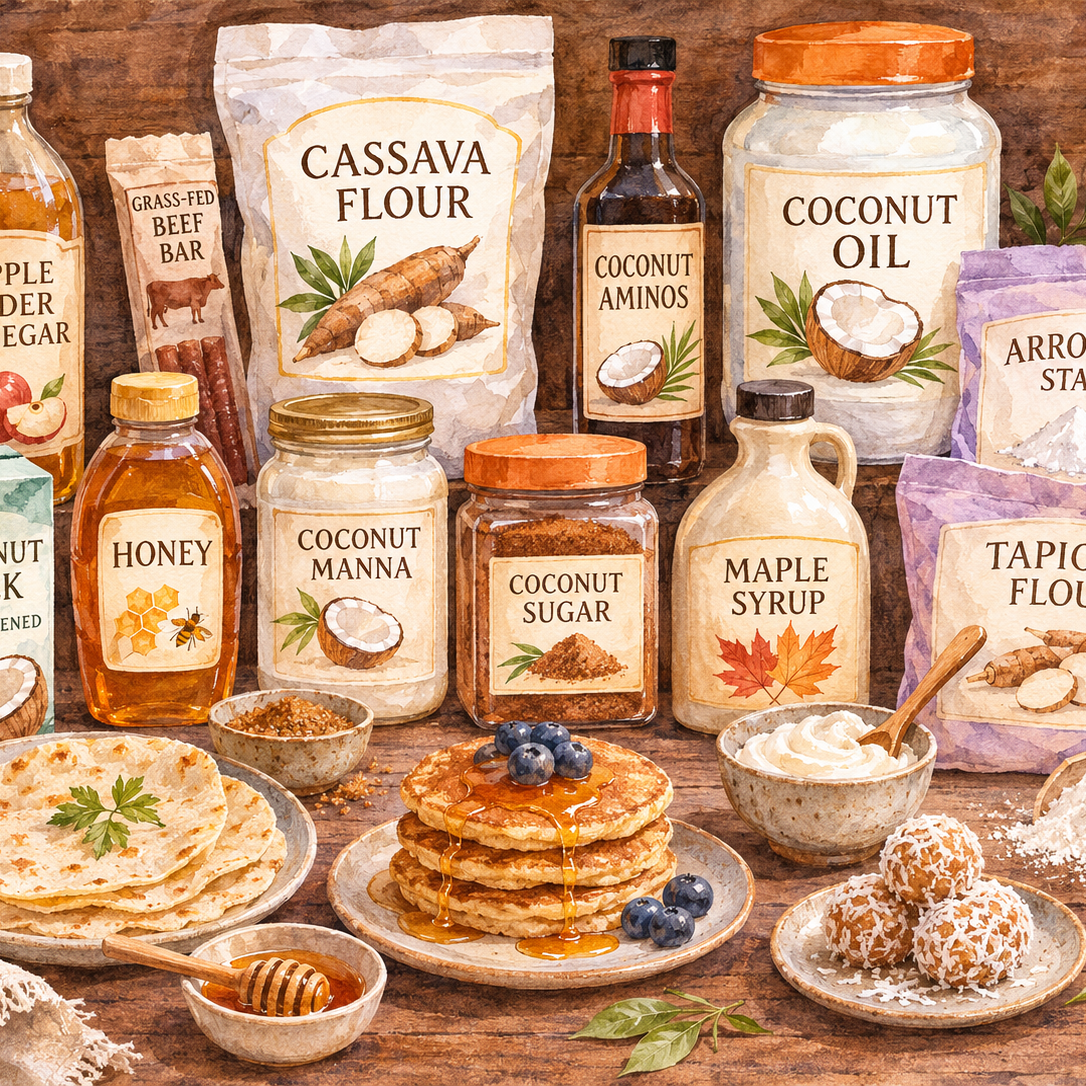
- Pantry Staple
- These are ingredients that are important to AIP cooking on a daily basis. It’s a good idea to have these on hand in the pantry for most AIP recipes. Keep in mind that honey, coconut sugar and maple sugar are still considered "added sugars".
- Apple cider vinegar
- Arrowroot starch
- Carob powder
- Cassava flour
- Coconut flour
- Coconut sugar
- Dried fruit
- Honey
- Maple syrup
- Tapioca starch
- Tigernut flour
- These are ingredients that are important to AIP cooking on a daily basis. It’s a good idea to have these on hand in the pantry for most AIP recipes. Keep in mind that honey, coconut sugar and maple sugar are still considered "added sugars".
Looking for easy ways to use these ingredients? Explore my AIP Mealtime Favorites.
Foods to Avoid During Traditional AIP
Now that we’ve established quite a long list of foods you can eat, let’s talk about the foods on the No-No list.
- Gluten and Grains
- These items can be reintroduced into the diet as tolerated following the conclusion of the elimination phase.
- Amaranth
- Barley
- Buckwheat
- Bulgar
- Corn
- Millet
- Oat
- Quinoa
- Rice
- Rye
- Sorghum
- Spelt
- Wheat
- These items can be reintroduced into the diet as tolerated following the conclusion of the elimination phase.
- Dairy
- This is one of those categories of foods that can promote allergies and inflammation, and work against the body while it’s trying to heal.
- Butter
- Cheese
- Cream
- Ghee
- Milk
- Yogurt
- This is one of those categories of foods that can promote allergies and inflammation, and work against the body while it’s trying to heal.
- Legumes
- Legumes can also be damaging to the gut lining and are best left out while going through the elimination phase.
- Black beans
- Chickpeas
- Fava beans
- Kidney beans
- Lentils
- Lima beans
- Peanuts
- Soy beans
- Legumes can also be damaging to the gut lining and are best left out while going through the elimination phase.
- Nightshades
- These veggies can be added back into the diet during the reintroduction phase.
- Eggplant
- Goji berries
- Ground cherries
- All peppers (spicy peppers, bell peppers, banana peppers, etc)
- All red spices
- Potato
- Tomato
- Tomatillo
- These veggies can be added back into the diet during the reintroduction phase.
- Nuts and Seeds
- Coconut and Tigernut are treated differently from tree nuts in the traditional AIP.
- Almond
- Brazil nut
- Canola
- Cashew
- Chia
- Coffee
- Cocoa
- Flax
- Hazelnut
- Hemp
- Pecan
- Pine nuts
- Pistachio
- Pumpkin
- Safflower
- Sesame
- Sunflower
- Walnut
- Coconut and Tigernut are treated differently from tree nuts in the traditional AIP.
- Seed and berry spices
- Again, not to worry, most of these ingredients can be reintroduced during the next phase!
- Allspice
- Anise
- Caraway
- Celery seed
- Cumin
- Fennel seed
- Mustard
- Nutmeg
- Black pepper
- Poppy seeds
- Again, not to worry, most of these ingredients can be reintroduced during the next phase!
- ALL ALCOHOL
- All eggs
- Eggs are actually one of the top allergens, and can irritate the intestines. Oddly enough, the yolk of the egg is less irritating than the white.
- All additives and sugar
- Gums, food dyes and any type of processed sugar does not promote healing in the body. However, if you want to use a sweetener, honey, maple syrup and coconut sugar are acceptable in small amounts.
Sidenote: This list follows a traditional AIP elimination diet rather than the modified AIP, which has different allowances.
Wow…what a list, right?? It’s a little overwhelming, and a little intimidating when you first look it over (or look it over a second…or third…or fifth time). Yes, that’s a lot of food on the NO list. But there’s actually a lot of GREAT food on the YES list! And remember…it’s not all about the food. Again, YES, the food is an important part, but it’s not everything. AIP is not just a diet. It’s truly a lifestyle change, and that includes working on improving stress, sleep, movement, and lifestyle in general. With some planning and preparation, you can definitely make it through the first 30 days!! And remember, you are not alone!
Need inspiration for using your AIP pantry staples? Try my apple pear scone cobbler recipe.
Once you're ready to expand your food choices, read my guide to the AIP Reintroduction Phase.
Download these FREE lists of Approved Foods & Foods to Avoid to help you stay on track!